Gas line help in Enid & nearby communitiesSuspect a leak? Safety comes first
Enid, Oklahoma · Residential gas piping

Gas Line Repair
in Enid, OK

Damaged pipe. An aging supply line. A new appliance.
Understand the problem and take the right next step.

Repair & replacementAppliance connectionsSafety-first guidance
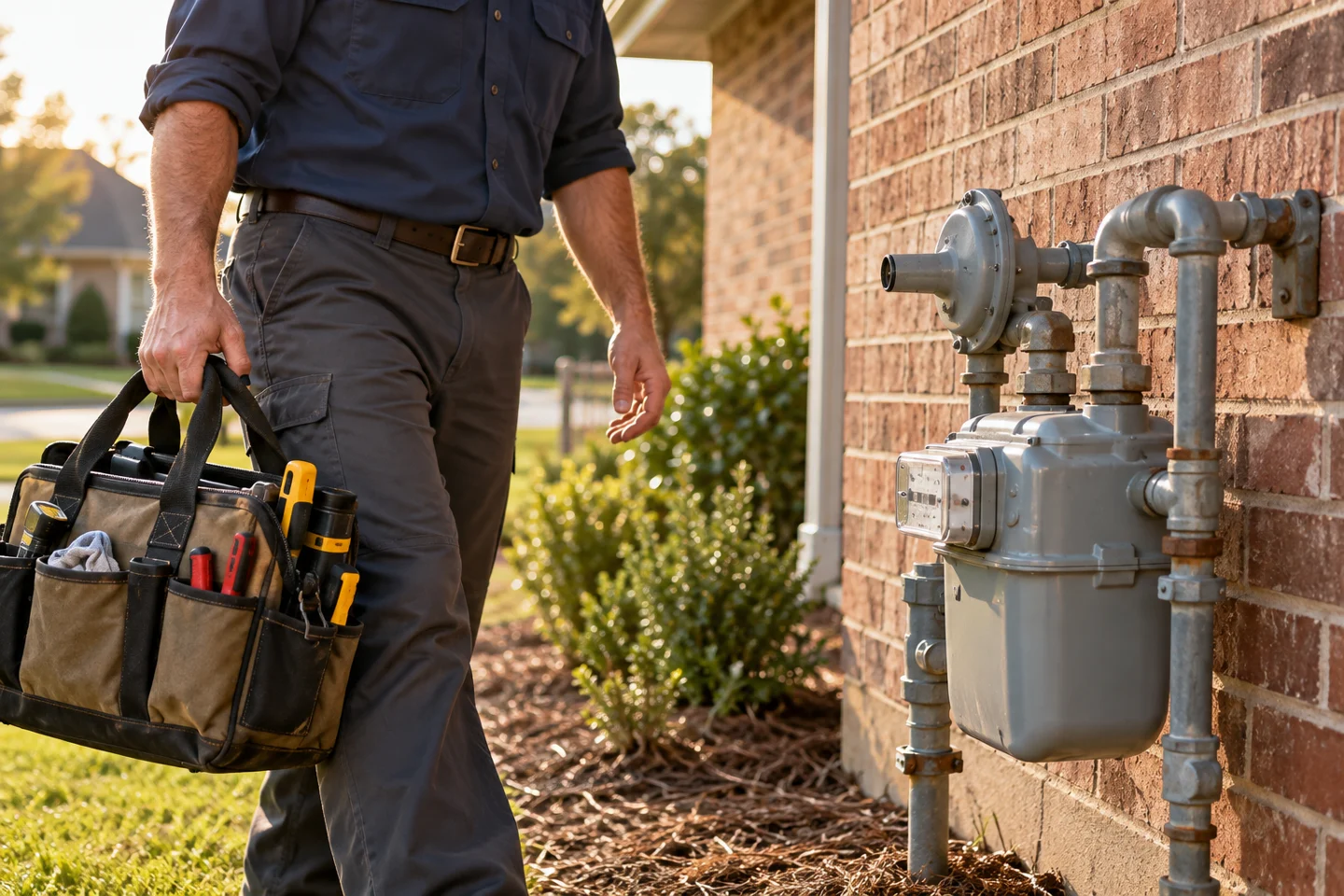
Gas meter at a brick home with a tool bag nearby
A small pipe. A big responsibility.Clear next steps for the gas supply your home depends on.
Clear answers before the next step

Gas line repair in Enid
starts with the right assessment.

Start with the condition of the line, the appliance it supplies, and the question you need answered.

What does gas line repair involve?

Gas line repair addresses a damaged, deteriorated, or leaking section of the piping that supplies gas appliances. It may involve a connection, an exposed pipe, a buried run, or a larger replacement when the remaining system is no longer suitable. A qualified professional evaluates the problem, identifies the affected section, and explains the work and testing needed before that section returns to use.

A repair inquiry does not always start with a gas smell. You might notice impact damage, receive a utility notice, plan to move a range, or discover piping that needs evaluation during a renovation. The first useful distinction is between an immediate safety concern and work that can be planned. A suspected active leak should be reported to emergency services and the gas utility from a safe location before arranging customer-owned piping repairs.

For planned work, explain the concern and the property location. Clear information about access, appliance requirements, and existing utility instructions helps define the next step. The aim is a suitable gas supply and an understandable scope of work, with responsibilities agreed before repairs begin.

The right service for the situation

Gas line services
for Enid homes.

Repair, replacement, inspection, and installation solve different problems. Start with the service that best describes your concern.

01 / GAS PIPING

Gas line replacement

Replacement may be appropriate when damage extends beyond one fitting, deterioration affects several sections, or a route needs a more substantial change. Understand the condition of the remaining pipe, the extent of removal, and how the finished system will be evaluated. Compare a limited repair with the full replacement scope before deciding.

Explore gas line replacement
02 / GAS PIPING

Gas line installation

A new gas line needs more than a convenient route to an appliance. Demand, fuel type, the existing supply, approved materials, access, and local approval requirements all shape the project. Planning early is especially useful when walls are open, a room is being remodeled, or an outdoor appliance is being added.

Explore gas line installation
03 / GAS PIPING

Gas leak detection

Leak detection identifies the source and extent of a suspected problem using professional evaluation appropriate to the system. An active gas odor is an emergency reporting situation first. Once the immediate hazard is addressed, understand whether the finding concerns customer-owned pipe, a connector, an appliance, or utility equipment.

Explore gas leak detection
04 / GAS PIPING

Underground gas line repair

Buried piping introduces access, ownership, utility locating, and restoration questions. A line to a detached structure or outdoor appliance may be customer-owned. Confirm the route and responsibilities before excavation. A complete plan addresses the affected piping, protection, testing, and what happens to the yard or hard surface afterward.

Explore underground gas line repair
05 / GAS PIPING

Appliance gas connections

Ranges, dryers, fireplaces, and outdoor gas appliances each have their own supply requirements. A new appliance may need a different connection or a revised branch line. Share the model and manufacturer instructions before work is scoped. Do not assume an existing connector, outlet, or supply is suitable for the replacement appliance.

Explore appliance gas connections
06 / GAS PIPING

Gas line inspection

An inspection helps establish what is visible, what requires further investigation, and whether repairs or changes are recommended. It can be useful after impact damage, during a remodel, or when reviewing unfamiliar piping. Ask for clear findings, the inspection limits, and any recommended tests or follow-up work.

Explore gas line inspection
Start with what you noticed

Gas line warning signs
and service needs.

You do not need to diagnose the pipe yourself. Explain what happened, where the concern is, and whether the utility has already been contacted.

Gas odor or suspected active leak

Leave the area and report the concern from a safe location. Emergency response comes before a routine service inquiry. Do not search for the source or operate switches.

Visible impact or corrosion

A bent exposed pipe, disturbed support, or visibly deteriorated surface deserves professional evaluation. Appearance alone cannot establish whether the piping is safe or which repair is appropriate.

An appliance is changing

A replacement range, dryer, or fireplace may have different fuel and supply requirements. The new appliance specifications should guide the connection review and any proposed branch-line changes.

A buried line or utility notice

Tell the professional whether the issue involves an underground run, a detached structure, or a notice from the utility. These details affect ownership, locating, access, and the approval process.

Know your system

Understanding your home’s
gas piping system.

A practical guide to the gas piping behind everyday heating, cooking, and appliance use. No repair instructions or guesswork.

Conceptual residential gas piping layoutAn underground supply approaches a gas meter outside a house. A property-side branch reaches a kitchen appliance and heating appliance. This schematic is not a construction plan.Gas meterProperty-side pipingRange connectionHeating applianceBuried supply section
Conceptual only. Pipe routes, materials, ownership boundaries, and appliance arrangements vary by property.

From the meter to the appliance

Think of gas piping as a connected system. A single visible fitting is only one part of the route, and a proper evaluation considers what surrounds it.

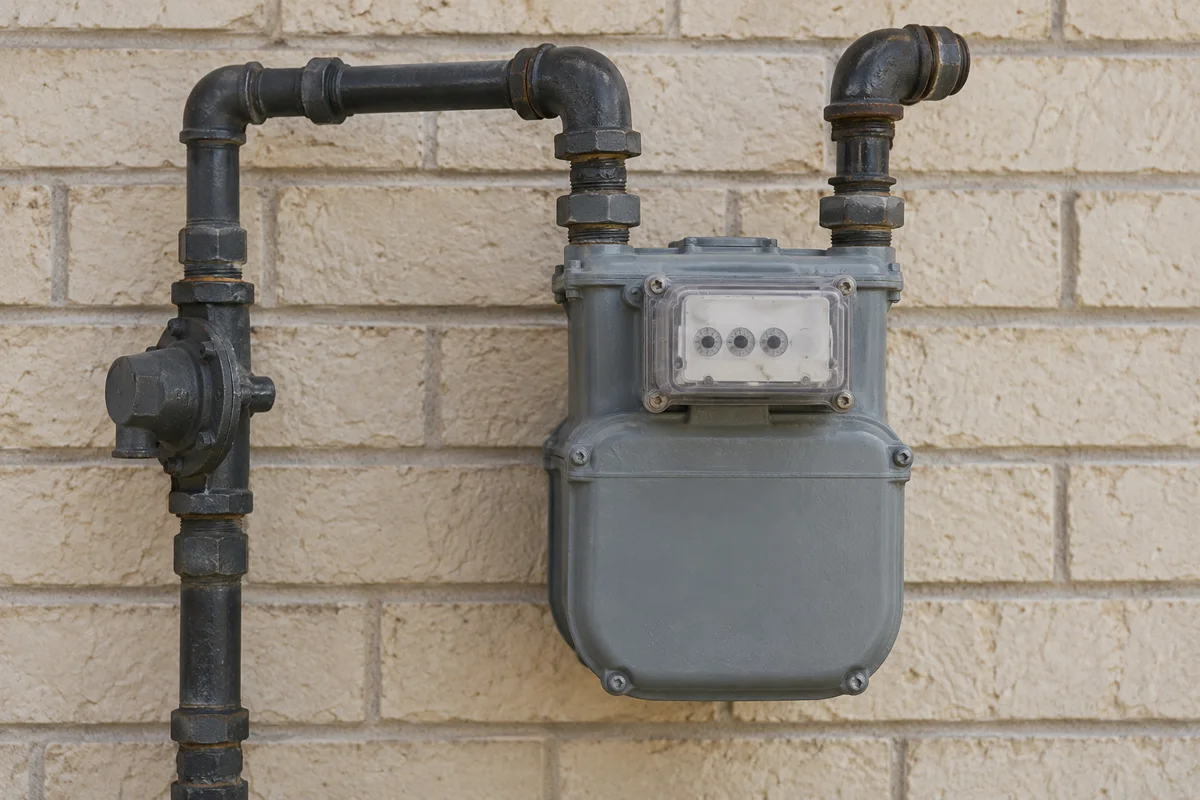
Gas meter and exposed piping on a brick wall

How residential gas piping fits together

Residential gas piping carries fuel from the supply point to appliances designed for that fuel. A property may have an exterior meter, a main customer-side run, and branch lines serving individual appliances. Some lines are visible; others may pass through walls, crawlspaces, or underground routes. The arrangement depends on the property, its history, and the appliances being supplied.

The meter, regulator, shutoff arrangements, branch piping, and appliance connectors serve different functions. A connector near a range is not the same thing as the entire branch line. A problem affecting one appliance may differ from an interruption affecting every gas appliance. These distinctions help a professional narrow the evaluation, but they are not a reason for a homeowner to manipulate piping or attempt a test.

Natural gas and propane installations are not interchangeable. Fuel type affects appliance compatibility and system design. Tell the person evaluating the line which fuel the property uses. If you are unsure, provide the utility or fuel supplier’s name rather than guessing. The same caution applies to inherited equipment, remodeled rooms, and appliance conversions.

Utility piping and customer-owned piping

Responsibility for gas equipment depends on the actual ownership boundary. Oklahoma Natural Gas explains that customer-owned piping and appliances are not maintained by the utility. This can include piping within a house and supply runs to secondary structures or outdoor equipment. The utility can clarify its own equipment and requirements, while a qualified professional evaluates the customer-owned section.

Avoid assuming that every pipe outside a wall belongs to the utility, or that every buried run is a utility service line. A private appliance supply can also be underground. When there is a utility notice, keep it available and ask which section is identified, what condition needs correction, and what documentation is needed for restoration. Do not remove a tag or attempt to turn service back on yourself.

Ownership affects the estimate as well as the work. A clear proposal identifies the customer-side section, any utility coordination, and the party responsible for inspection or restoration. If the concern is at the meter or utility supply, contact the utility rather than treating it as an ordinary appliance connection repair.

Pipe materials, corrosion, and physical damage

Gas piping can include rigid steel, approved flexible piping systems, and materials suitable for particular buried applications. Selection and joining requirements depend on the system, location, manufacturer instructions, and applicable codes. Corrugated stainless steel tubing, commonly called CSST, is distinct from a short appliance connector. It has its own installation and bonding considerations that require professional review.

Corrosion can affect exposed or buried metallic components, especially where protection or environmental conditions are unfavorable. A rust-colored surface does not reveal wall thickness or prove the extent of deterioration. A professional assesses the affected section and surrounding conditions before deciding whether a localized repair is reasonable or a longer replacement is needed.

Physical impact, movement, an altered appliance position, or work by another trade can disturb piping and connections. A bent line or pulled connector should not be pushed back into position as a temporary fix. Report what changed and keep the area undisturbed. A gas line inspection can help define the condition and the limits of what can be verified without further access.

Repair, replacement, and a better installation plan

A limited repair may make sense when the fault is isolated and the remaining piping is suitable. Replacement becomes a different discussion when deterioration is distributed, the layout is unsuitable, or the existing supply no longer matches the intended use. These decisions should follow the findings, rather than a fixed rule based only on the age of the home or the appearance of one fitting.

Gas line replacement should have a defined start and end point, a material and access plan, and clear expectations for any affected surfaces. For new gas line installation, appliance demand and the existing system are part of the design. A larger appliance cannot be judged solely by whether its connector fits an existing outlet.

Before approving work, ask why the proposed scope solves the identified problem. Find out whether adjacent piping has been assessed, whether the new route changes access or protection, and whether another appliance is affected. For an outdoor project, consider the placement of the appliance and the future use of the space before the route is finalized.

Evaluation, professional testing, and local approvals

A professional evaluation begins with the concern, system history, and accessible piping. Leak detection and other testing are selected to answer specific questions; they are not interchangeable with a casual visual check. Where work requires testing, the professional determines the method and applicable requirements. This site does not provide testing pressures, valve instructions, or repair procedures for homeowners.

Permits and inspections depend on the project and the authority having jurisdiction. The City of Enid publishes construction and trade-permit resources through Community Development. Its construction application includes gas inspection categories. A property in a neighboring town or outside municipal limits needs its own jurisdiction confirmed rather than assuming Enid’s process applies.

Ask who arranges approvals, when inspections occur, and what must be complete before the repaired section is returned to service. Utility restoration may involve a separate step when service has been interrupted. Keep copies of the estimate, findings, permit or inspection records where applicable, and completed-work documentation so future appliance changes have a clearer starting point.
For a suspected active leak

Leave first.
Call from a safe place.

Gas odor or a suspected leak needs an emergency response before routine repair planning. Do not stay inside to investigate or try to make the area safe yourself.

Read Oklahoma Natural Gas guidance

Avoid flames, cigarettes, switches, electrical devices, and other potential ignition sources. Oklahoma Natural Gas advises against using a phone in the affected area or opening and closing windows or garage doors. Do not start a nearby vehicle. Leave promptly and use your phone only once you are away from the suspected leak.

From a safe location, call 911 and your gas utility’s emergency number. Oklahoma Natural Gas customers can report a natural gas emergency at 800-458-4251. If your property uses a different supplier, use that supplier’s emergency contact. The routine service number on this website is not the emergency reporting route.

Remain away until emergency responders or the gas utility say it is safe to return. Do not restart appliances, remove utility notices, or restore gas service yourself. Once the immediate hazard is controlled, any required work on customer-owned piping can be discussed separately. Scheduled repairs, inspections, and appliance upgrades without an active leak are a different situation and can be planned around their actual scope.

A practical path forward

Gas line evaluation
and repair planning.

01

Describe the concern

For a non-emergency issue, explain what changed, where the piping is located, and whether an appliance or utility notice is involved. State your property location and any known access constraints.

02

Clarify the findings

A professional evaluates the affected section and explains the evidence. Ask whether the issue is isolated, whether surrounding piping needs review, and whether further access or testing is necessary.

03

Agree on the work

Confirm the repair or replacement boundaries, estimate, approvals, testing, utility coordination, and restoration responsibilities. The next step should reflect the specific system and the findings, rather than a generic promise.

What affects gas line repair cost?

The cost depends on the actual line and the work required. An accessible connection, a run inside a finished wall, and an underground gas line repair have different access requirements. Pipe length and material are only part of the estimate; fittings, support, testing, approvals, and restoration may also be involved.

Ask for a written scope that distinguishes pipe work from access and finishing work. Wall repair, landscaping, and pavement restoration can change the total project cost even when the damaged section is small. If the line serves multiple appliances, find out whether the work affects another branch and whether those appliances require coordination during the interruption.

For planned appliance gas connections, provide the model, fuel type, and location so the supply can be reviewed before quoting. A larger input rating or a moved appliance may mean a line change rather than a connector-only job. Timing also depends on inspection and utility requirements, so confirm the anticipated sequence rather than assuming gas can be restored immediately when pipe work is finished.

No single Enid price accurately describes all of these situations. Compare proposals using the same scope, included testing, approvals, and restoration responsibilities. An inexpensive partial proposal may leave important project costs outside the figure you first see.

Repair or replacement?

The condition and suitability of the whole affected section guide the decision. Use these questions to understand the recommendation.

SituationPossible directionWhat to ask
One isolated damaged connectionA focused repair may be considered.Is the adjacent piping suitable, and what confirms the completed repair?
Deterioration across several sectionsA longer replacement may be appropriate.Where does the replacement start and end, and why?
Appliance demand or location changesAn installation or supply revision may be needed.Has the existing system been assessed for the new appliance?
Buried line with uncertain conditionLocating and further evaluation may come first.Who owns the section, and what access or restoration is included?

A repeated problem should trigger a discussion about the underlying cause. Replacing the same small part again may not address movement, exposure, an unsuitable arrangement, or deterioration elsewhere.

Gas range and navy cabinets in a bright kitchen

What to have ready when calling

Describe the issue in ordinary words: a damaged exterior pipe, a replacement range, a utility notice, or a concern about a buried run. Include your town, the indoor or outdoor location, and when the concern began. Explain whether service is currently off and whether a professional or utility has already assessed it.

For an appliance project, keep the model and fuel type handy. For repairs, mention access constraints and any written findings. Gather only what is safely available; never enter an affected area or move an appliance to collect details during a suspected leak. You can review the contact checklist before a planned inquiry.

Enid & surrounding communities

Gas line help in Enid
and nearby communities.

Enid is the primary focus for gas line repair information and service inquiries. Nearby North Enid, Waukomis, Garber, and Lahoma are included because a precise property location helps clarify the inquiry and the relevant approval process. Call to confirm availability for your address and the kind of piping work you need.

North Enid is its own incorporated community next to Enid. Waukomis is south of Enid, Garber is to the east, and Lahoma is to the west. These place names are useful starting points, but a mailing address alone may not establish the authority responsible for a particular project. Mention whether the property is within town limits or outside them.

The local pages explain different planning questions, from town-boundary identification to coordinating work beyond Enid. They do not assume every home uses the same fuel, material, or piping layout. A property-specific evaluation remains the basis for the scope. Tell the professional if the home uses propane rather than a utility natural gas supply.

For a multi-location inquiry, give each property’s own location and the issue at that address. Access, existing utility instructions, and approval requirements may differ even when the same appliance type is involved. Availability and appointment timing should be confirmed directly; proximity does not establish a response-time commitment.

Questions homeowners ask

Gas line questions,
answered clearly.

From ownership and approvals to appliance changes, understand the details before work is agreed.

What does gas line repair involve?

It starts with finding the actual problem and determining which section of piping is affected. Depending on condition, a professional may repair a connection, replace a damaged segment, or recommend a broader replacement. Evaluation, required testing, and any necessary approvals belong in the scope. An apparent appliance problem does not automatically mean the gas line needs replacing.

What should I do if I smell gas?

Leave the affected area immediately. Avoid switches, flames, electrical devices, garage doors, and nearby vehicle ignition. Use a phone only after reaching a safe location. Call 911 and your gas utility’s emergency line. Oklahoma Natural Gas lists 800-458-4251 for its customers. Stay away until the utility or emergency responders say it is safe to return.

Does the gas utility repair all piping at my property?

No. Utility equipment and customer-owned gas piping have different responsibilities. Oklahoma Natural Gas states that it does not maintain customer-owned natural gas piping or appliances. Ask the utility to identify the boundary for your property. A meter location alone does not establish who owns every buried or exposed section, and a repair estimate should clearly name the section involved.

Can a damaged gas line be repaired rather than replaced?

Sometimes, when damage is localized and the surrounding piping remains suitable. Widespread deterioration, repeated problems, or an unsuitable route may make replacement more practical. The decision depends on evidence from the property. Ask why a proposed repair is sufficient, what nearby piping was assessed, and what testing will confirm the completed work.

What affects gas line repair cost in Enid?

Accessibility, pipe length, fittings, material compatibility, excavation, required permits, testing, and restoration all affect the scope. An exposed connection and a buried line beneath a hard surface are different projects. Request a written estimate that separates gas piping work from wall, yard, or pavement restoration. A reliable price requires a clear description of the actual problem.

Can a new range or dryer use the existing gas connection?

Not automatically. The appliance fuel type, input rating, connector requirements, location, and existing supply must be checked. The connector is only one part of the installation. A move across a room or an increase in appliance demand may require changes upstream. Share the manufacturer’s installation information before purchasing materials or scheduling delivery.

Who handles permits and inspections?

Confirm responsibility with the professional preparing the work and the authority having jurisdiction over the property. Enid publishes construction and trade-permit information through Community Development. Nearby incorporated towns and properties outside municipal limits may have different approval arrangements. Ask what inspections apply and how completed approvals will be documented before the project begins.

Does a carbon monoxide alarm detect a natural gas leak?

A standard carbon monoxide alarm is not a substitute for natural gas detection. Carbon monoxide and natural gas are different hazards; carbon monoxide is odorless. Some devices have multiple sensors, so follow the specific product instructions. A quiet alarm never overrides a gas odor or other warning sign. Leave and report a suspected gas leak from a safe location.

Can I arrange gas piping work in a nearby community?

Call with the exact property location to discuss availability in North Enid, Waukomis, Garber, or Lahoma. Include whether the property is inside town limits and whether the issue concerns indoor piping, an appliance, or a buried section. Coverage, appointment timing, and approval requirements should be confirmed for the particular project rather than assumed from proximity.

What information should I have ready for a call?

For a non-emergency inquiry, describe the location of the concern, when it began, any utility notice, and the appliance involved. Mention whether service is already off and whether access involves a crawlspace, wall, yard, or detached structure. For a planned installation, have the appliance model and fuel type available. Do not reenter an unsafe area to gather details.

Talk through your next step

Let’s start with the gas line problem.

Call to discuss the issue, your location, and service availability.

Call (580) 555-0137
Call (580) 555-0137