Underground Gas Line Repair in Enid, OK
Buried piping needs a plan for the line itself—and for locating, access, approvals, and the ground above it.
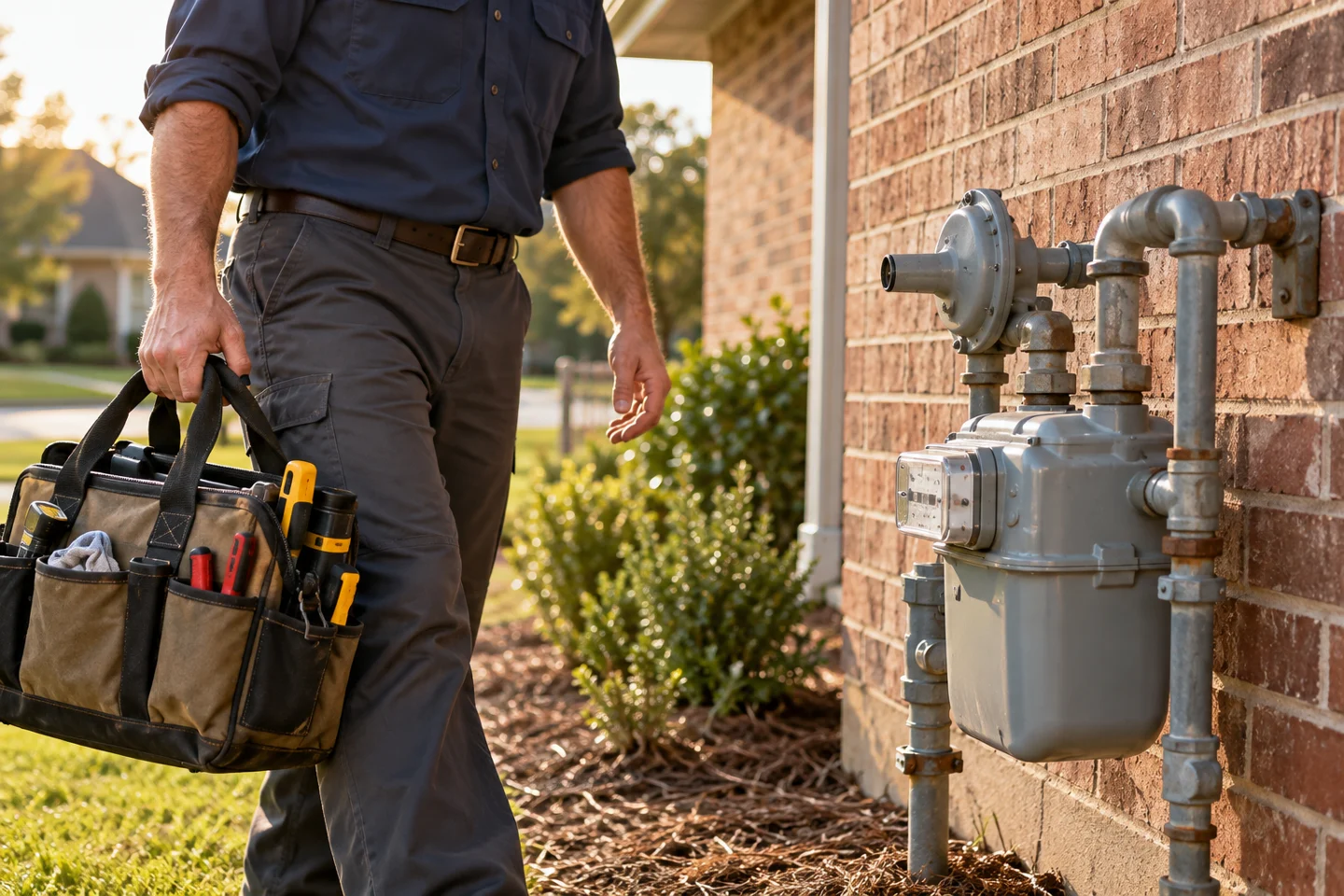
Why a buried line needs a separate plan
Underground gas line repair addresses an affected buried section of piping. The line may supply a house, a detached building, or an outdoor appliance, and its ownership must be established before the work is defined. A utility service line and a customer-owned appliance supply can both be below ground, but they do not have the same maintenance responsibilities.
The route, access, condition, and surrounding services influence the project. A visible outdoor connection may not reveal the entire buried arrangement, and a general property sketch may not prove the exact location. A qualified professional evaluates the concern and coordinates the appropriate locating, access, repair or replacement, testing, and approval requirements.
For gas pipe repair in Enid, explain whether the suspected section is in a yard, beneath a surface, or between structures. Include any utility notice or known recent excavation. Do not begin digging to expose the line yourself. If gas odor or another warning suggests an active leak, leave and report it to emergency services and the gas utility from a safe location first.
Clarifying ownership and what the line serves
Start by identifying the line's purpose and ownership. Oklahoma Natural Gas explains that it does not maintain customer-owned piping, including certain runs to secondary structures or outdoor equipment. The boundary should be confirmed for the property, especially when the suspected section is near the meter or the route is not well documented. Do not infer ownership simply because the pipe is outside the house.
A customer-owned line to a grill or detached structure may need separate evaluation and repair arrangements. Tell the professional which equipment is supplied and whether other appliances share the system. If the property uses propane, provide the fuel supplier and equipment information so the planning does not assume a utility natural gas installation.
Available records can help establish a starting point: prior work documents, utility notices, appliance installation information, or a route sketch. Treat a sketch as context rather than a substitute for appropriate locating. Ask which elements of the route are confirmed and whether additional information is required. Clear ownership and destination details reduce the risk of approving work on the wrong section or overlooking utility coordination.
Locating before excavation
Contact 811 before excavation is planned. Utility locating is an important part of preparing work around buried services, but it may not identify privately owned lines beyond the utility's responsibilities. A customer-owned gas supply, private electrical run, or other private service may require additional locating. Ask the professional how private lines will be addressed before ground disturbance begins.
Marks should not be treated as an invitation to dig without a safe work plan. The excavation team must follow the applicable locating and safe-digging requirements for the site. Homeowners should not probe, trench, or disturb a suspected gas line. If a line is struck or damaged, stop and follow emergency guidance rather than attempting to cover it, seal it, or turn it back on.
Describe planned landscaping, fence work, pavement changes, or other excavation that may be occurring at the same time. Coordination matters because separate contractors may be working near the same services. Agree who obtains locates, how the work area is communicated, and what happens if the route differs from expectations. The gas repair scope should include these practical dependencies rather than focus only on pipe length.
Condition, repair boundaries, and replacement options
A buried pipe can be affected by corrosion, unsuitable protection, physical damage, or changes around the route. The material and installation conditions should be assessed rather than assumed from the age of the property or the community. A defect exposed in one place may be isolated, or it may raise questions about a longer section. The professional explains what the evidence supports.
A localized repair and a full run replacement have different implications for access and restoration. Ask why the proposed boundary is appropriate, whether remaining piping has been assessed, and whether a revised route offers a practical benefit. The replacement guide provides questions for comparing those options without assuming that the most extensive work is always necessary.
Material selection, joining, protection, and any transition to above-ground piping depend on the actual system and applicable requirements. These are professional design and installation decisions. You do not need instructions on depth, pressure testing, or fitting assembly to evaluate the proposal. Instead, ask for a clear description of the planned route, affected section, approval responsibilities, and confirmation process for the completed work.
Access, hard surfaces, and restoration
A buried repair is also an access project. A line in an open yard presents different constraints from a section below a driveway, patio, or established landscaping. The pipe work may be only part of the cost. Ask how the team expects to reach the affected section and what assumptions about surface removal are included in the estimate.
Restoration should be defined separately. Backfilling, rough grading, replacing turf, rebuilding a patio, and matching concrete are different tasks. The gas piping scope may include some and exclude others. Clarify who handles each item, what condition will remain after the repair, and whether another contractor must return after required inspection steps are complete.
For a planned outdoor gas installation, route planning before surface work can prevent avoidable rework. For an existing buried failure, discuss whether restoration timing depends on inspection or other review. Avoid assuming that an attractive surface finish is included because the estimate uses the word “complete.” Compare proposals using the same access and restoration expectations.
Testing, approval, and preparing your inquiry
The completed piping requires whatever testing and approvals apply to the project. A professional determines the methods, requirements, and safe sequence. Inspection may need to occur while work is accessible, and utility restoration can be separate when service has been interrupted. Do not cover work or restore gas yourself to move the project along.
Property jurisdiction matters, especially outside Enid. A location in Garber or Lahoma may have its own approval arrangement, while a property outside municipal limits needs that status clarified. Explain the exact location and whether the line crosses into a detached structure or other part of the property. The appropriate authority should be established before the work sequence is finalized.
For a non-emergency call, have the known destination, surface conditions, utility notice, and recent digging history available. Say whether gas service is off and whether the route is uncertain. Discuss availability for the buried line project with those details. Do not collect photographs or records by approaching an unsafe area. Afterward, keep the documented route and completed-work information to assist future excavation planning.
Common questions
Is every buried gas pipe maintained by the utility?
No. Customer-owned piping can also run below ground, including supply to outdoor equipment or detached structures. Confirm the boundary with the utility and professional. A buried line's appearance or location does not establish ownership, and the correct repair arrangement depends on identifying the actual section.
Does an 811 request identify every private line?
Not necessarily. Utility marking may not cover customer-owned lines beyond utility responsibilities. Discuss private-line locating with the professional before excavation. Give any available route documentation as context, but do not rely on a sketch or a past mark as proof of the current line location.
Can a buried line be repaired without replacing the entire run?
A focused repair may be possible if the problem is isolated and remaining piping is suitable. Broader deterioration or an unsuitable route may support replacement instead. Ask what condition has been confirmed and why the proposed start and end points are appropriate. Access and restoration should be part of the comparison.
Will yard or pavement restoration be included?
Check the written scope. Excavation and pipe work do not automatically include landscaping, turf replacement, concrete matching, or patio rebuilding. Ask which restoration tasks are included, which need another trade, and how required inspections affect the closing of the work area. Compare estimates against the same finishing expectations.
What if the concern began after fence or yard work?
Tell the professional what work occurred, where it happened, and when the concern began. Do not excavate to investigate or attempt to cover damaged piping. If a leak is suspected, leave and report it from a safe place. The recent-work history helps frame evaluation after immediate safety concerns are addressed.
What documentation is helpful for future projects?
Keep the completed scope, applicable approvals, and any route information supplied after the work. These records can assist future planning, but they do not replace a current locating request before digging. Ask the professional which records describe the customer-owned section and which conditions or limitations should be understood later.
Let’s start with the gas line problem.
Call to discuss the issue, your location, and service availability.